A lot of organizations are built on a quiet assumption: people cannot be trusted with too much freedom.
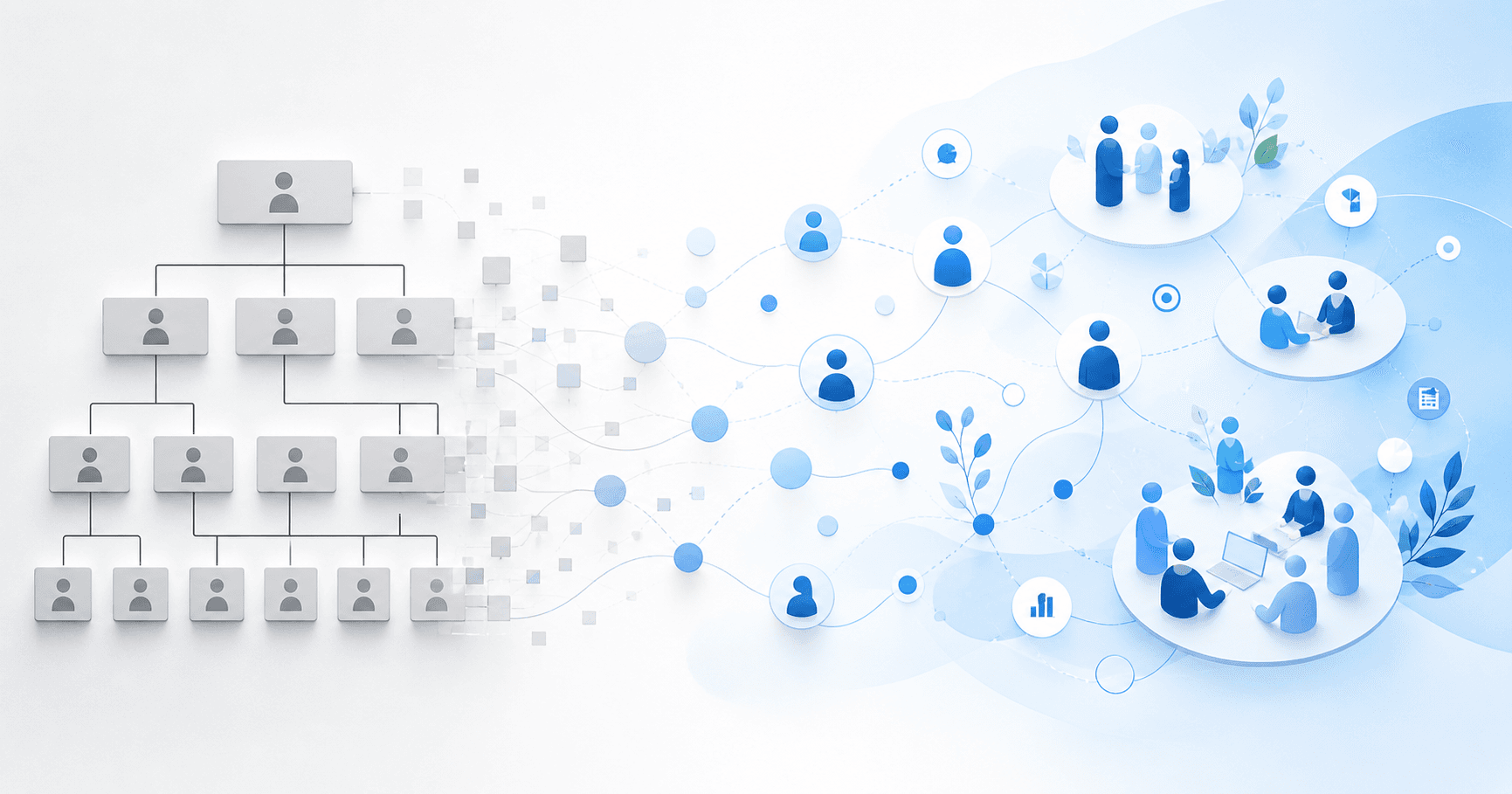
So decisions move upward. Permission gets centralized. Roles become boxes. Work gets measured more than understood. People closest to the problem are asked to execute decisions made by people farther away from the reality of the work.
That is bureaucracy at its most familiar. It is not always malicious. Sometimes it even starts as a reasonable attempt to create order. But over time, the system begins to protect itself. The process becomes more important than the purpose. The org chart becomes more important than the work. People learn to wait, escalate, comply, and manage perception instead of taking initiative.
The result is not just inefficiency. It is wasted human potential.
Heirloom exists because I believe there is a better way to build: not a world with no structure, but one where structure helps people contribute more fully. Ownership, voice, and trust should not be rare privileges inside organizations. They should be part of how meaningful work is organized from the beginning.
The problem with bureaucracy is distrust
Gary Hamel and Michele Zanini's Humanocracy is useful because it names something many people feel but struggle to articulate. Bureaucracy makes organizations less human by assuming that control should sit above contribution.
In a bureaucratic system, authority usually comes from position. Information travels through channels. Permission moves slowly. Coordination depends on managers, meetings, approvals, and escalation paths. The organization may say it wants creativity, but the system rewards caution.
Humanocracy argues for a different design philosophy: organizations should be built around the capabilities of the people inside them. That means more ownership, more openness, more experimentation, deeper community, and influence that comes from competence and contribution rather than rank.
This is not a call for chaos. It is a call for better structure. The opposite of bureaucracy is not everyone doing whatever they want. The opposite is a system where people have enough clarity, trust, and agency to solve problems without waiting for permission at every step.
What human-centered organizations do differently
A human-centered organization starts from a different assumption: people are not just resources to be allocated. They are capable of judgment, creativity, responsibility, and care.
But those qualities only show up when the system gives people room to use them. You cannot ask people to act like owners while hiding decisions from them. You cannot ask for creativity while punishing mistakes. You cannot ask for commitment while treating contribution as invisible.
The strongest human-centered organizations tend to combine five things:
- Ownership: people share in the value they help create.
- Voice: people have a real path to shape decisions that affect the work.
- Transparency: people can see the information, tradeoffs, and context needed to act responsibly.
- Visible contribution: work is recognized, reviewed, and connected to outcomes.
- Trust with accountability: people have autonomy, but not ambiguity.
That last point matters. Human-centered does not mean structureless. In fact, trust without structure is fragile. Without clear rules, people start relying on vibes, politics, personality, and memory. The goal is not less structure. The goal is structure that protects human agency instead of smothering it.
Ownership alone is not enough
The research on shared capitalism is helpful because it keeps the argument honest.
Shared ownership, profit sharing, gain sharing, broad-based stock options, worker cooperatives, and ESOPs all point toward a similar intuition: people behave differently when they share in the upside of what they help build.
But the evidence does not say that ownership magically fixes an organization. The stronger lesson is that ownership works best when paired with real participation, information sharing, good supervision, training, and trust.
In one NBER working paper, Douglas Kruse, Richard Freeman, and Joseph Blasi found that greater involvement in shared capitalism programs was generally linked to greater participation in decisions, higher quality supervision and treatment, more training, higher pay and benefits, greater job security, and higher job satisfaction. But they also emphasized that whether workers gain by sharing depends on other workplace policies.
That caveat is the point. Ownership without voice can feel like risk transfer. Voice without ownership can feel symbolic. Trust without transparency can collapse. Participation without structure can become exhausting.
The better model is not ownership by itself. It is ownership plus voice, transparency, contribution, and accountability.
Related: For the practical ownership model behind Heirloom, read Build Together, Own Together.
Voice is what turns ownership into agency
If people are expected to think like owners, they need some way to act like owners.
That does not mean every decision should be democratic. Some decisions need expertise. Some need speed. Some should be delegated. But when the direction of the work, the distribution of credit, the use of shared resources, or the future of the organization is at stake, people need a real path to participate.
This is where many organizations fail. They offer the language of ownership but keep the logic of bureaucracy. Employees are told to care, but decisions remain opaque. Contributors are told they matter, but contribution is not tracked. Members are invited into the mission, but not into the mechanics.
A human-centered organization cannot rely on inspiration alone. It needs systems that make participation practical.
On Heirloom, this shows up through proposals, voting, tasks, and rewards. A person sees something that should change. They make a proposal. The team chooses the right decision rule. If it passes, the decision becomes work. When the work is completed, the contribution is recognized.
That loop matters because it connects voice to execution. It keeps participation from becoming theater.
Related: For the decision-making side of Heirloom, read Choose Together, Build Together.
Worker cooperatives show this is not just theory
Worker cooperatives are not perfect, and not every project should become one. But they are important because they combine ownership and voice structurally. The people doing the work are also the people who participate in governing the organization.
The research base is more encouraging than many people assume. Reviews of worker cooperative studies have found that worker cooperatives can survive at least as long as conventional firms, often preserve employment more strongly in downturns, and can be as productive as or more productive than comparable conventional firms.
The most interesting part is not simply that cooperatives can perform well. It is why. When people have voice and ownership, they often make different tradeoffs. In downturns, worker-owned firms may choose to protect jobs before maximizing short-term returns. In daily operations, members may care more about information, participation, and long-term resilience because they are not just labor inside the system. They are stewards of it.
That does not mean every team needs formal democratic governance on day one. It means early teams should learn from the principle: people who help build the organization should not be treated as disposable inputs to it.
What human-centered design looks like in practice
The best examples are not identical. That is useful. It shows that human-centered organization design is not one legal form or one management trend.
Buurtzorg, the Dutch home-care organization, is often cited for its nurse-led self-managing teams. Its model reduces reliance on layers of management by trusting professionals closer to the patient to coordinate care. The lesson is not that every organization should copy Buurtzorg. The lesson is that autonomy can work when teams have clear purpose, local context, and accountability to the people they serve.
Morning Star, a tomato processor known for self-management, uses commitments between colleagues instead of traditional managerial hierarchy. Again, the lesson is not that titles must disappear everywhere. The lesson is that coordination can come from clear promises, peer accountability, and mission-focused work rather than command alone.
Haier is a more extreme large-company example, with its microenterprise model built around smaller, customer-facing units. It is useful less as proof that every company should restructure the same way, and more as proof that even large organizations can question the assumption that hierarchy is the only path to coordination.
These cases are not laboratory experiments. They are examples of managerial imagination. The stronger evidence comes from the ownership, participation, and high-involvement work literature. But the cases help make the research feel concrete: people can coordinate with more trust and less bureaucracy when the system is designed for it.
Why this matters more now
The future of work is not waiting for organizations to become healthier.
Gallup's 2026 State of the Global Workplace report found global employee engagement fell to 20% in 2025, its lowest level since 2020, with low engagement costing the world economy an estimated $10 trillion in lost productivity.
At the same time, the World Economic Forum's Future of Jobs Report 2025 projects structural labor-market transformation equal to 22% of today's total jobs by 2030. AI, automation, economic uncertainty, demographic shifts, and the green transition are all changing what work requires.
That combination matters. If work is changing quickly, then organizations need people who can learn, adapt, speak up, coordinate, and create. But bureaucracy trains people to wait. It narrows responsibility. It makes initiative risky. It separates the people with information from the people with permission.
A more human-centered economy will need better companies, but it will also need better early teams, better co-ops, better programs, better community organizations, and better ways for people to build outside the traditional corporate path.
That is the space Heirloom is trying to serve.
The lesson for early teams
Early teams do not usually fail because they lacked a formal hierarchy. They fail because contribution, responsibility, and ownership were never made clear.
A founder has an idea, but collaborators are not sure whether they are helpers or co-builders. A community wants to move forward, but decisions live in scattered messages. A co-op has values, but the operating work is still buried in meetings and memory. A program brings people together, but the momentum disappears after the cohort ends.
The research points toward a practical stack:
- Shared purpose: people need to understand what they are building and why it matters.
- Visible work: contribution should not depend on who remembers what happened.
- Real voice: people need a path to shape decisions that affect the work.
- Transparent information: people cannot act like owners if context is hidden from them.
- Fair upside: if the project creates value, the people who carried it should have a principled path to share in that value.
- Clear accountability: trust grows when expectations are explicit and follow-through is visible.
This is the middle path between bureaucracy and chaos. It is not control for control's sake, and it is not vague optimism about collaboration. It is human-centered structure.
How Heirloom applies this
Heirloom is not trying to replace trust with software. That would miss the point. The goal is to give trust somewhere to live.
A Loom gives a team a shared home for the idea, the people, the work, the decisions, and the contribution history. Dynamic equity gives teams a way to let ownership emerge from real work instead of early guesses. Proposals and voting give contributors a way to shape direction. Tasks and contribution records make work visible. Originals create on-ramps for people who want to build but do not yet have a team or fully formed idea.
The product is still software. But the deeper bet is organizational: more people will build meaningful things if they have a structure that respects their contribution from the beginning.
Human-centered organizations are not built by saying “people matter” in a mission statement. They are built by designing systems where people can actually act, contribute, decide, learn, and share in the value they create.
The caveat: human-centered does not mean easy
It would be dishonest to pretend this is simple.
Shared ownership can create risk if people are overexposed to one organization. Participation can become slow if every decision requires input. Voice can become performative if the real decisions happen elsewhere. Trust can collapse if people do not know what is expected. Contribution tracking can become political if the rules are unclear.
That is why the serious version of this argument is not “everyone should own everything together and figure it out.”
The serious version is this: if we want organizations that bring out more of what people are capable of, we need systems that pair human agency with real structure. Ownership needs voice. Voice needs information. Trust needs accountability. Contribution needs visibility. Autonomy needs shared purpose.
That is harder than bureaucracy in some ways, because it asks more of people. But it also gives more back.
We can build organizations worthy of the people inside them
The old bargain asked most people to trade agency for stability. Follow the process, stay in your lane, wait for permission, and maybe the system will take care of you.
That bargain feels weaker every year.
As work changes, we need organizations that can use more of what people have to offer: their judgment, creativity, care, taste, curiosity, relationships, and willingness to build something that matters.
That will not happen by accident. It requires new habits, new tools, and new structures for working together.
Heirloom is one attempt to build that structure at the beginning, when projects are still fragile and teams are still forming. If people are going to build together, they deserve a system that helps them see the work, shape the decisions, trust the rules, and share in what they create.
Beyond bureaucracy is not a fantasy of no rules. It is the work of building better ones.
Build with ownership, voice, and trust
Request early access and we'll help set up a workspace around your team's real coordination work.
Request Early AccessHeirloom provides collaborative tools and templates to help teams organize work, decisions, and contribution history. Nothing on this page is legal, tax, employment, or investment advice. If your team formalizes ownership, governance rights, compensation, or a legal entity, consult appropriate counsel.
Sources and further reading
- Gary Hamel and Michele Zanini, The Principles of Humanocracy.
- Gary Hamel and Michele Zanini, Excess Management Is Costing the U.S. $3 Trillion Per Year, Harvard Business Review.
- Kruse, Freeman, and Blasi, Shared Capitalism at Work, NBER / University of Chicago Press.
- Kruse, Freeman, and Blasi, Do Workers Gain by Sharing?, NBER Working Paper.
- Dube and Freeman, Complementarity of Shared Compensation and Decision-Making Systems, NBER.
- Carberry, Kim, Han, and NCEO summary, Feeling Like Owners.
- Virginie Pérotin, What Do We Really Know About Worker Co-operatives?.
- U.S. Department of Labor, Employee Ownership Initiative Report to Congress.
- Gallup, State of the Global Workplace 2026.
- World Economic Forum, The Future of Jobs Report 2025.
- The Commonwealth Fund, Home Care by Self-Governing Nursing Teams: The Buurtzorg Model.
- Morning Star, Mission-Focused Self-Management Model.